


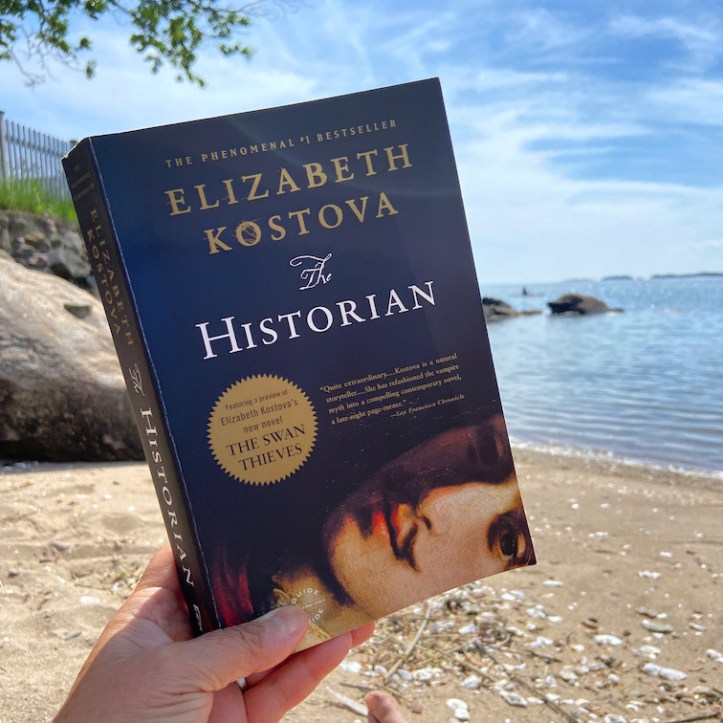
This was my second read of The Historian by Elizabeth Kostova. I read it when it was first published in 2005. There was A LOT of pre-publication buzz about this novel because the author had been given a two-million dollar advance, which was unheard of at the time, especially for a first novel. The publisher was hoping it would be the next Da Vinci Code.
I had mixed feelings after that first reading. For me, it didn’t live up to all the hype. I thought the concept was fantastic, but the execution was flat. I had written that, “it lacked body and seemed to be more of an outline.” I wasn’t sure what I meant by that. This novel is certainly much more than an outline. It is full of rich details, intricately plotted, and includes of variety of voices and places.
Here’s the publisher’s blurb:
Late one night in 1972, as a 16-year-old girl, she discovers a mysterious book and a sheaf of letters in her father’s library—a discovery that will have dreadful and far-reaching consequences, and will send her on a journey of mind-boggling danger. While seeking clues to the secrets of her father’s past and her mother’s puzzling disappearance, she follows a trail from London to Istanbul to Budapest and beyond, and learns that the letters in her possession provide a link to one of the world’s darkest and most intoxicating figures. Generation after generation, the legend of Dracula has enticed and eluded both historians and opportunists alike. Now a young girl undertakes the same search that ended in the death and defilement of so many others—in an attempt to save her father from an unspeakable fate.
Vlad Tepes is Kostova’s Dracula
Spoiler alert: In a nutshell, Dracula (who in this novel is the historic Vlad Țepeș) is alive and looking for someone to catalog his vast book and manuscript collection. Over the centuries, he’s collected everything written about himself, as well as various topics of interest. Whenever a talented historian pops up on Dracula’s radar, he or one of his minions, “gives” the historian a book that is empty except for a woodcut printing of a dragon on the middle pages. Some historians poke around to learn about the mysterious book that has entered their life, but most don’t go all that far.
Professor Rossi of Oxford is the best and the brightest. His protege, Paul, has such a book appear in his study carrel where he’s working on his dissertation. After Rossi shows Paul his own such book and hands over the research he’d done years before, the good professor disappears. Paul goes in search of his mentor. Fast forward about twenty years and Paul is now the father of the 16 year old girl mentioned in the publisher’s blurb above. When her dad starts acting weird, she starts snooping and finds the book. Dad slowly starts to spill the beans. He disappears and she goes after him.

Just as Bram Stoker used a variety of “documentation” to make the hunt of his Dracula seem real, Kostova creates a variety of letters, maps, and post cards to go back and forth in time to “re-create” this inter-generational hunt for Dracula. The plot winds through the story of Rossi’s experience in the 1930s, Paul’s in the 1950s, and then the unnamed narrator in the 1970s. There’s an Epilogue set years later when the narrator is now well into her own career as a historian.
Three strikes and you’re out
The three romantic partnerships lack chemistry. They are straight and narrow. Paul is a big drip and eventually got on my nerves. Helen even writes to her daughter that he could have found her if he’d tried, but he never did try.
Upon reading the novel a second time, I think what I meant after the first reading — that it seemed more like an outline — is that the storytelling lacks drive and passion. There are some thrilling moments, but for the most part, the story is dusty and slow with little variation in pacing or tone. It is also perhaps the least sexual, sensual, or queer vampire novel ever written. There is no sucking or intermingling of blood. If a victim is bitten three times by a vampire, they will turn into a vampire. The vampire mythology in this book is as straightforward as American baseball. Three strikes and you’re out.
This is not to say that I didn’t enjoy The Historian the second time around. I did. What shines in this novel is the history and travel. The library and archive scenes are delightful, as are the descriptions of historians doing research — “I knew, as a historian, that the order of any archival find is an important part of its lesson” (54). Words to warm an archivist’s heart.
Dracula’s murder of humans isn’t the only evil in this book. His attempt to control history and the archival record by manipulating history workers is a real horror. Helen tells her daughter (the narrator) that, “He seemed always to have liked scribes, archivists, librarians, historians — anyone who handled the past through books” (663).
“I will put many archivists at your disposal — the finest of them — and you shall bring more under our power.”
Dracula to Rossi
Much of the story is set during the Cold War and the threat of the Soviets trying to erase history and/or control the narrative is also one of the horrors. Paul comments that the “cheerless bureaucrats” in Budapest seemed “embalmed in oppression” (462). Dracula, further east, survived in the past by manipulating monks. It seems clear that the Iron Curtain is now helping his cause as well. He can move about freely, but others are slowed down by bureaucracy and travel restrictions.
I’m holding on to this copy of The Historian because I can see myself reading it yet again. Something about it has gotten under my skin. I recommend this novel to readers who like stories with librarians, archivists, historians, research action, and eastern European history and travel. Diehard vampire fans will no doubt want to have this one under their belt.
The Historian by Elizabeth Kostova
First published June 14, 2005 by Little, Brown and Company
Edition I read and pictured above: Back Bay Books, 2009
676 pages – a Big Book Summer Challenge read